Native iOS and Android app development (Swift & Kotlin)
Premium-quality iOS and Android apps built to run directly on your users' phones.
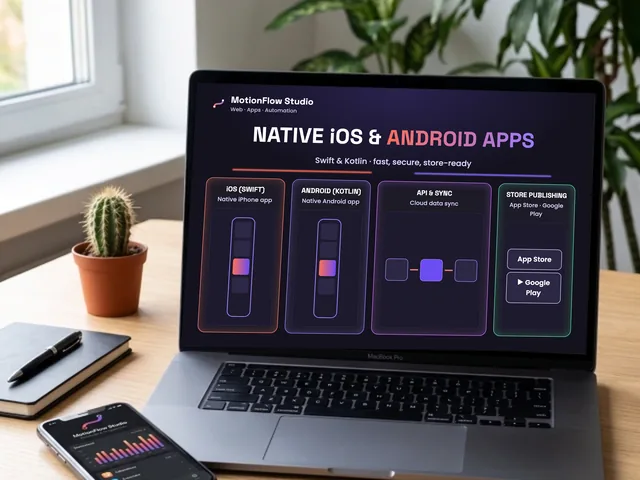
This service focuses on designing and building premium-quality mobile apps made directly for users' phones (iOS and Android) with the platforms' official, native technologies: Apple Swift / SwiftUI and Google Kotlin / Jetpack Compose.
Compared with cross-platform hybrid solutions, genuine native coding gives lightning-fast performance, perfectly fluid animations, offline capability and direct access to the devices' hardware features (camera, GPS, Bluetooth, biometric authentication, push notifications). The aim is to hand over a stable, secure and scalable mobile product that immediately meets the strict quality requirements of the Apple App Store and Google Play.
Which tasks and areas does the service cover?
- Native iOS development (Apple ecosystem)
- Building modern interfaces on Swift and SwiftUI for iPhone and iPad.
- Native gestures, navigation and dark/light mode handling that follow Apple's Human Interface Guidelines (HIG).
- Integration with Apple services (Sign in with Apple, Face ID / Touch ID, Apple Pay, CoreData, CloudKit).
- Native Android development
- Building modern interfaces in Kotlin with the Jetpack Compose architecture, optimized for all common screen sizes.
- A native experience that follows the Material Design guidelines, battery-friendly background processes (WorkManager) and Room database handling.
- Connecting Google Play Services (Google Sign-In, Google Pay, BiometricPrompt).
- Central REST API and cloud sync
- Secure communication with an existing or new company back end (Django, Node.js, Firebase or a custom REST/GraphQL API).
- Offline-first operation: the app stays usable without an internet connection and syncs the data automatically when the network returns.
- Hardware integrations and advanced modules
- Bluetooth (BLE) communication with IoT devices, hardware accessories or sensors.
- Camera, QR and barcode scanning, document scanning and location (GPS / geofencing).
- Targeted push notifications (Firebase Cloud Messaging / APNs) to keep users active.
- App store publishing (App Store & Google Play)
- Configuring developer accounts (Apple Developer Program, Google Play Console).
- Preparing the mandatory privacy statements, store screenshots and descriptions, and managing the whole approval process (App Review).
The steps of the project
- Specification and technical architecture: We lay down the data models, the working logic of the screens and the structure of the API endpoints.
- Native client development: I build the interfaces and internal logic of the iOS (Swift) and Android (Kotlin) apps, in parallel or by priority.
- API connection and hardware testing: I set up real-time data sync and test the hardware modules (camera, Bluetooth, notifications).
- Thorough device testing: I check stability, battery use and edge-case errors on real physical devices.
- Submission and going live: I prepare the store packages (IPA, AAB) and see the app through store approval to live availability.
What does the handover include?
- The full, clean and documented native source code (Swift / Kotlin) in version control (Git).
- The working, tested installation files (TestFlight iOS build, Android APK/AAB).
- Successful store approval and a live release on the App Store and Google Play.
- A detailed technical description of the API connections and build processes.
How we work and how it is priced
- Milestone-based fixed pricing: Depending on the size of the project, handover and invoicing are split into clear stages (Architecture & UI -> Core features & API -> Testing & store publishing).
- Approval guarantee: The price includes immediately fixing any store rejections on the technical side, guaranteeing the release.
Frequently asked questions
Why choose pure native technology (Swift / Kotlin) over hybrid solutions?
Native code runs directly on the operating system's official engine: Swift/SwiftUI on iOS and Kotlin/Jetpack Compose on Android. That guarantees maximum hardware speed, butter-smooth 120 Hz animations, low battery use and direct hardware access (Bluetooth, Face ID, camera, background processes). In the long run it is far more stable, because new iOS and Android system updates do not break third-party intermediary frameworks.
Do the iOS and Android versions have to be built separately, or can both be built at once?
The interfaces and native features are written separately in Swift and Kotlin, according to each platform's own standards. This can happen in parallel or in stages (for example, validating the market on one system first). The database in the background and the REST API connection, however, are completely shared: the user can sign in with the same account and sees the same data whichever phone they are using.
Will you see the app through submission and approval on the App Store and Google Play?
Yes, the process does not end when the code is written. I help configure the company or individual developer accounts (Apple Developer Program, Google Play Console), prepare the store screenshots, icons and privacy statements required for the upload, and then submit the packages for review (App Review). I handle any questions and technical feedback, guaranteeing a successful release.
Does the app keep working without signal or an internet connection?
Yes, it can be built specifically for so-called offline-first operation. It securely records data and completed actions in the phone's own built-in database (CoreData or Room) even when there is no mobile network. As soon as the device reconnects to the internet, the app syncs the new data with the central server in the background, unnoticed and without conflicts.
Can the app communicate with external hardware, IoT devices or sensors?
Absolutely. The biggest advantage of native development is unlimited, low-level hardware access. Whether it is your own microcontroller, a Bluetooth Low Energy (BLE) module, scales, temperature sensors, camera-based document and QR scanning or geofencing-based location, the system controls the connected devices stably and without delay.